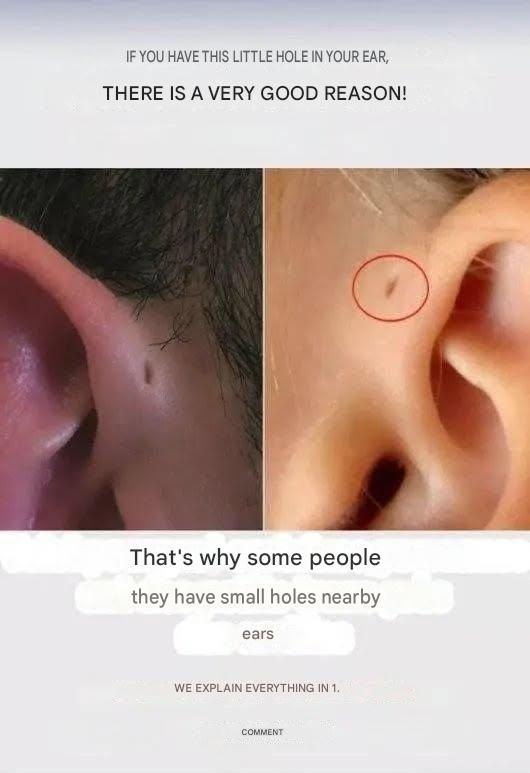
Parents, pay close attention to your children’s ears, especially where they connect to the face.
Do you see a small hole (like the picture above)?
This small opening is known as the bronchial fossa.
It is also found by other names such as bronchial sinus or fistula. The hole is formed as a result of a malformation of the ear in the sixth week of pregnancy.
In fact, this small opening is the entrance to the paranasal sinus, which is constantly intertwined under the skin of the ear. The sinus canal can be short or long, with several branches forming a zigzag shape in the auditory tissue.
Bronchial fossa in a child: a congenital leaky defect
of the child’s ear
This innocent hole usually doesn’t cause any problems, but if you notice anything worrisome, consult your doctor.
Neil Shubin, professor and associate dean of the Department of Biological Sciences at the University of Chicago, explains that the bronchial fossa is “an evolutionary remnant of fish gills.” Needless to say, just having that little hole doesn’t make you (or your child) a mermaid or an alien.
The bronchial opening was first documented by a scientist named Van Heusinger in 1964. Typically, this small opening is only in one ear, but about 50% of people have it in both ears.
A bronchial opening near the ear is considered a birth defect because children generally do not have such openings.
These dimples can also resemble a dimple rather than a hole. Fortunately, this condition is quite rare – it affects only about 5% of the world’s population. Both sexes are affected by this condition equally.
In addition, although not all parents have bronchial fossa, there is a high probability that it is a hereditary disease if both ears of the child are affected.
Keep in mind that there are certain ear conditions that can be confused with bronchial fossa disorders.
Respiratory growths are small bumps of skin in the ear area. They do not have a fistula, so they are not at risk of infection. At best, they are only cosmetic and do not cause potential problems such as leaking dimples.
A gill fissure cyst is a more serious condition that initially manifests itself as a small opening, a skin growth, or a dimple around the neck. These cysts, resembling sacs with excess tissue, are susceptible to infection and require drainage.
Respiratory cavity in infants and potential risks
Warning signs
Although rare, these openings can sometimes be associated with various ear and sinus infections. Therefore, the pediatrician will refer the child to an ENT specialist if he knows that he has a bronchial fossa. The laryngologist will examine the child more closely to rule out any serious problems.
Wiyarni Pambudi, a pediatrician and certified lactation consultant of the International Board, says bronchial orifices do not require medical intervention and can be left untreated. However, there are a few warning signs that are worth paying attention to.
Not all children have the same symptoms, but here are the most common symptoms that require treatment by an ENT specialist: